
We use limited cookies
We use cookies where necessary to allow us to understand how people interact with our website and content, so that we can continue to improve our service.
View our privacy policyWe use cookies where necessary to allow us to understand how people interact with our website and content, so that we can continue to improve our service.
View our privacy policyGood Law Project survey shows 71% of UK adults think the law doesn’t do enough to protect survivors from legal action
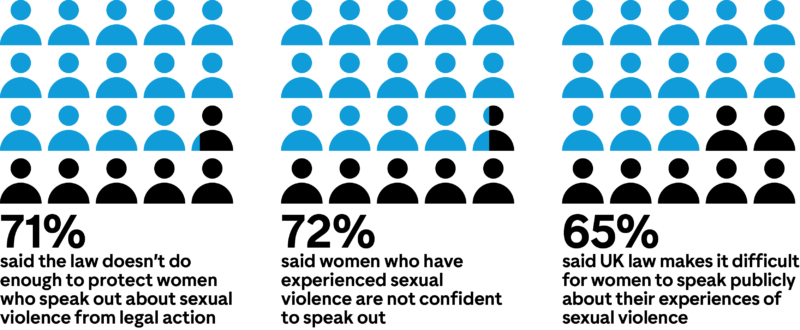
A poll has shown how our legal system is failing women who speak out about sexual violence, with more than seven in 10 UK adults saying the law doesn’t do enough to protect them from legal action.
The survey found the same proportion think most women who have experienced sexual violence are afraid to speak out, and 65% think that UK law is a barrier.
Defamation laws in the UK put women who speak out about sexual violence at risk of legal action from the men who attacked them. Wealthy and powerful men make highly aggressive and intimidating legal claims – called Strategic Lawsuits Against Public Participation (SLAPPs) – knowing that the women must prove that what they said was true and they will be faced with crippling legal bills. For many, these threats, and fear of them, make it easier to stay silent.
That’s why Good Law Project has been helping women speak out. Women like Nina Cresswell, who faced down her attacker and forced the police to admit their failures. Or like Liv Nervo, who broke the wall of silence her former partner built after tricking her into pregnancy.
We think the law needs to be rebalanced to put an end to the intimidation tactics and to remove the risk of excessive costs in public interest cases – including those involving sexual violence – because silencing women who have experienced sexual violence puts other women in danger.
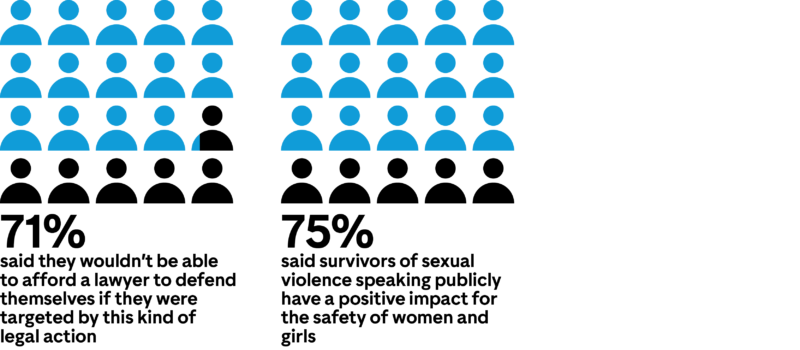
And people across the UK agree. When Good Law Project commissioned an online survey from Deltapoll, three quarters of the 2,000 people who took part said that survivors of sexual violence speaking publicly about their experiences have “a positive impact for the safety of women and girls”. And more than seven in 10 said they wouldn’t be able to afford a lawyer to defend themselves if they found themselves the target of this kind of legal action.
For Matthew Gill, Good Law Project’s specialist defamation lawyer, the survey reveals a “dangerous failure at the heart of UK law that has been weaponised by the rich and powerful”.
“When you look around the world,” Gill said, “the UK sticks out like a sore thumb. Our outdated defamation laws stack the deck against the brave women who speak out about sexual violence. The law allows abusers to use their wealth and power to make it impossible for women to talk about their experiences, continuing the abuse. It’s way past time for the justice secretary to bring forward anti-SLAPP laws that are fit for the 21st century.”
Last year, a study from The Gemini Project (PDF) revealed that 71% of women facing legal action after surviving abuse said the case was brought against them by a former or current romantic partner, or their abuser. More than a quarter of women who took part in the study said the legal action was “intended to silence them”, with a further 22.4% saying they were targeted to protect a “public reputation” and 15.4% saying that the case was brought because of a dispute about the allegations.
More than 85% of respondents said that the proceedings had a “significant impact” on their mental health, with 83.3% saying that the legal claim had affected their “ability to work” and 87% revealing an impact on their “ability to complete daily tasks”.
Over 75% said that the legal action had worsened their finances. One woman said that legal fees had placed her “in financial difficulties”, while another confessed that “the fear of escalating costs” was always on her mind.
According to The Gemini Project’s Lucy Nevitt, speaking out on sexual violence plays a vital role in “raising awareness, challenging stigma, and helping to protect other women and girls”.
“If this government is serious about tackling violence against women and girls,” Nevitt said, “it must recognise that protecting those who speak out is an essential part of that commitment. We need comprehensive anti-SLAPP legislation to address the gap in legal protections and safeguard survivors of sexual and gender-based violence from legal abuse.”
