
We use limited cookies
We use cookies where necessary to allow us to understand how people interact with our website and content, so that we can continue to improve our service.
View our privacy policyWe use cookies where necessary to allow us to understand how people interact with our website and content, so that we can continue to improve our service.
View our privacy policyA UK guide for women (and men)
About this guide
This guide was produced by Good Law Project. It was last updated on 22 October 2026. If you have any questions or suggestions, please get in touch with Good Law Project via our website.
Disclaimer
This guide does not constitute legal advice and should not be relied on as such. Instead, specialist advice should be sought on your specific circumstances.
Historically, hidden cameras were relatively easy to identify. Today, devices like Meta Ray-Ban smart glasses are making non-consensual filming harder to spot. By seamlessly embedding microphones, artificial intelligence, and high-definition cameras into ordinary looking glasses, smart glasses allow wearers to record continuously unbeknown to those around them. Many devices display an LED light when they are recording, but some users have worked out a way to disable this feature. As a result, unlike smartphones that require a deliberate pointing motion, these glasses can capture first-person footage instantly and invisibly, fundamentally shifting public privacy dynamics.
This stealth capability has prompted venues like Wetherspoon pubs to ban smart eyewear. Media reports throughout 2026 highlight the severity of the issue:
Further escalating these privacy concerns is the integration of artificial intelligence. A student-developed prototype named I-XRAY showed how real-time facial recognition linked to Meta glasses could instantly identify and dox strangers.
In response to growing backlash, Meta modified its devices in July 2026 so that the camera disables itself if the front recording LED is tampered with. Concurrently, Instagram pledged to delete harassing pickup content, though reporters continued to find such clips months later. By September 2026, the Minister for Women and Equalities clarified to Parliament that misuse can breach existing voyeurism laws, emphasising the legal responsibility of social networks to take down non-consensual media.
In the UK, being filmed in public is rarely illegal. However, legal boundaries can be breached once the footage is uploaded, monetized, sexualized, or used to target an individual.
Incident |
Legal Status |
Recommended Action |
||
|---|---|---|---|---|
| Casual recording in public spaces (streets, parks, beaches) | Usually legal. There is no blanket ban on public filming. | Object verbally and request deletion. If persistent or uploaded, proceed with the steps below. | ||
| Persistent filming or following | Can constitute stalking or harassment. | Report to the police, contact the National Stalking Helpline, or seek a civil injunction. If uploaded, submit a complaint to the host platform, demand the uploader remove it. |
||
| Identifiable, non-consensual footage, published online | Can be unlawful under data protection and privacy regulations, particularly if monetised, engagement-driven, or in a private place. Can also constitute harassment if published to weaponize an online audience against you |
Submit a complaint to the host platform, demand the uploader remove it, and alert the ICO.Report to the police if publication has led to harassment | ||
| Recorded in an intimate setting (bedroom, changing room, toilet) or during sexual activity | Frequently criminal (e.g., voyeurism). | Report to the police and contact the Revenge Porn Helpline. | ||
| Sharing or threatening to leak intimate media | Criminal offence. | Report to the police, and contact the Revenge Porn Helpline and StopNCII.org. | ||
| Demanding payment for video removal | Potential blackmail. | Refuse payment, preserve communications, and report to the police. | ||
| Doxxing or receiving threatening comments | Platforms are legally obligated to remove illicit content; threats can be criminal. | Report the account and individual comments. Report threats to the police. | ||
| Captions spreading damaging lies | Potential defamation. | Consult a legal professional. | ||
| Creation or distribution of sexual deepfakes | Both creating and sharing are criminal offences. | Report to the police, and contact the Revenge Porn Helpline and StopNCII.org. | ||
Capturing hidden footage in public is not inherently illegal in the UK. The legality hinges entirely on the context: the location, whether the person is identifiable, the nature of the recording, and its subsequent use.
Some legal mechanisms come into play, or are stronger, if a video is distributed online, provided you are identifiable and the clip is publicly accessible. Seek legal advice as these claims are complex and expensive.
In reality, enforcement is patchy at best. When a journalist sent Meta more than 20 videos, it removed nine, and one account was initially banned then came back with its videos restored. If videos are not removed after making a complaint, keep making reports.
Save screenshots and copies of video before you report anything, because when a post comes down it may be difficult to prove what happened later. After that, several of these steps can run at the same time.
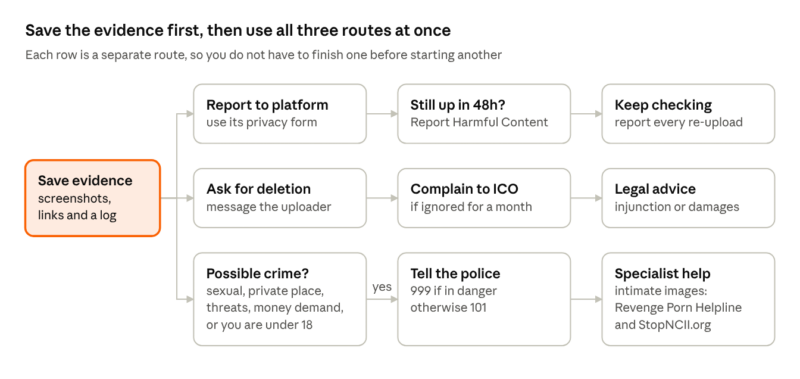
Start on the left. The top two routes work for any posted video; add the bottom route if a crime may be involved.
Report each offending comment, message, story, and post separately, even if it feels repetitive to do so. A pattern of content reports builds a record against the account that a single account level report does not; reviewers can see exactly what was flagged, when, and under which category, which strengthens any later escalation.
You can say no, walk away and get help. You do not owe anyone a conversation or your contact details.
